Organizations are entering a new era of workforce management where artificial intelligence is becoming a strategic driver of business performance. Human resources leaders are under increasing pressure to improve employee experiences, accelerate talent acquisition, optimize workforce planning, and enhance productivity while managing growing operational complexity.
Generative AI is rapidly emerging as a transformative technology that enables HR teams to automate repetitive tasks, generate actionable insights, and deliver personalized employee support at scale. By combining advanced language models with workforce data and business processes, organizations can improve decision-making, increase efficiency, and create more agile HR functions.
As businesses continue their digital evolution, generative AI is helping HR departments move beyond traditional administrative responsibilities and become strategic contributors to organizational success. Its ability to generate content, analyze information, support employees, and streamline workflows is reshaping how HR teams operate across the entire employee lifecycle.
The Rise of Generative AI in HR
Generative AI in HR refers to the use of advanced artificial intelligence models that can create content, generate recommendations, answer questions, summarize information, and automate knowledge-based tasks. Unlike conventional automation tools that follow predefined rules, generative AI can understand context, generate human-like responses, and support more sophisticated workforce interactions.
HR organizations are increasingly adopting generative AI to improve efficiency, enhance employee engagement, and support strategic decision-making. These solutions can assist with recruiting, onboarding, learning and development, performance management, workforce planning, and employee communications.
One of the primary reasons organizations are investing in generative AI in HR initiatives is the technology’s ability to simplify complex processes while improving the quality and speed of HR services.
1. How generative AI differs from traditional HR technology
Traditional HR systems are primarily designed to store data, manage transactions, and automate repetitive workflows. Generative AI expands these capabilities by creating content, generating insights, and supporting conversational interactions.
For example, generative AI can draft job descriptions, create employee communications, summarize policy documents, generate learning content, and answer employee questions in natural language. This significantly improves efficiency while reducing manual effort.
2. Key capabilities of generative AI in HR
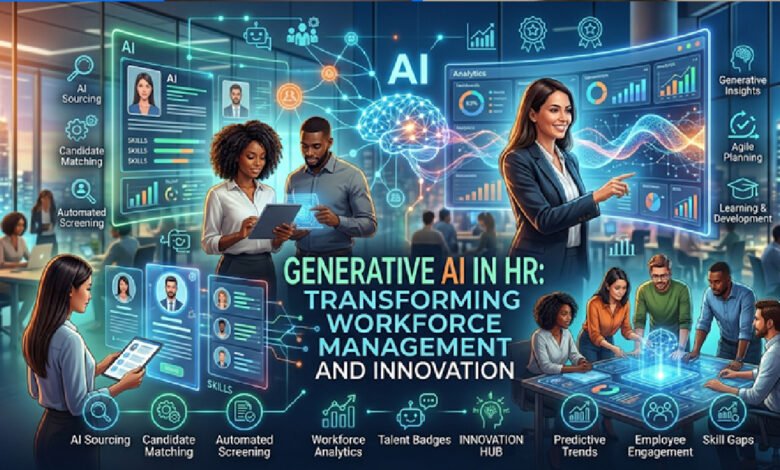
Modern generative AI solutions offer a wide range of capabilities that support workforce transformation, including:
- Automated content generation
- Conversational employee support
- Knowledge management assistance
- Workforce analytics insights
- Talent acquisition support
- Learning and development personalization
- Employee communication enhancement
- Process automation assistance
These capabilities help HR teams improve service delivery while increasing operational effectiveness.
3. The growing role of AI-powered workforce transformation
As organizations pursue workforce modernization initiatives, generative AI is becoming an important component of broader digital transformation strategies. The technology enables HR leaders to improve employee experiences, optimize workforce operations, and support business growth through data-driven decision-making.
Businesses seeking to accelerate workforce modernization often incorporate generative AI as part of broader digital transformation consulting initiatives that align technology investments with organizational goals.
Benefits of Generative AI in HR
Generative AI offers significant benefits across HR functions by improving efficiency, enhancing employee experiences, and supporting strategic workforce management.
1. Increased operational efficiency
One of the most immediate benefits of generative AI is the automation of time-consuming administrative tasks. HR professionals often spend considerable time drafting communications, answering employee questions, updating policies, and managing documentation. Generative AI can automate many of these activities, allowing HR teams to focus on higher-value strategic initiatives.
2. Improved employee experience
Employees increasingly expect fast, personalized, and accessible HR support. Generative AI-powered assistants can provide instant responses to employee inquiries, guide users through HR processes, and deliver relevant information when needed. This improves employee satisfaction while reducing response times and support workloads.
3. Enhanced talent acquisition
Recruitment teams can use generative AI to streamline hiring processes and improve candidate experiences. AI-powered tools can generate job descriptions, personalize candidate communications, summarize interview feedback, and assist with sourcing efforts. These capabilities help organizations attract and engage top talent more effectively.
4. Better workforce decision-making
Generative AI can analyze large volumes of workforce data and generate meaningful insights that support strategic planning. HR leaders can use these insights to identify workforce trends, monitor employee engagement, and evaluate talent strategies. Access to actionable intelligence helps organizations make faster and more informed decisions.
5. Personalized learning and development
Learning and development programs become more effective when training content is tailored to individual employee needs. Generative AI can create customized learning materials, recommend relevant courses, and support career development planning. This improves workforce capabilities while supporting continuous learning initiatives.
6. Stronger knowledge management
Organizations often struggle to manage large volumes of HR policies, procedures, and institutional knowledge. Generative AI can help employees quickly locate relevant information, summarize complex documents, and provide contextual guidance. This improves accessibility while reducing administrative burdens on HR teams.
Use Cases of Generative AI in HR
Organizations across industries are implementing generative AI to improve workforce operations and enhance employee experiences.
1. Recruitment and candidate engagement
Generative AI can support recruiters throughout the hiring process by generating job descriptions, creating interview questions, drafting candidate communications, and summarizing applicant profiles. These capabilities help improve hiring efficiency while creating a more engaging recruitment experience.
2. Employee onboarding support
Effective onboarding plays a critical role in employee engagement and productivity. Generative AI can create personalized onboarding content, answer new hire questions, and provide guidance throughout the onboarding journey.
This helps organizations accelerate employee readiness and improve early-stage engagement.
3. HR service delivery
Many employee questions involve policies, benefits, payroll, and workplace procedures. Generative AI-powered assistants can provide immediate responses to common inquiries, reducing dependency on HR service teams.
This improves service delivery while enabling HR professionals to focus on more complex employee needs.
4. Learning and development content creation
Training materials often require significant time and effort to develop. Generative AI can generate course content, create knowledge assessments, summarize educational materials, and personalize learning experiences.
Organizations benefit from faster content development and improved workforce learning outcomes.
5. Performance management support
Generative AI can assist managers by summarizing performance feedback, drafting evaluation comments, identifying development opportunities, and supporting coaching conversations.
These capabilities help improve consistency and effectiveness across performance management processes.
6. Workforce planning and analytics
Organizations can use generative AI to interpret workforce data, identify emerging trends, and generate strategic recommendations. HR leaders gain better visibility into workforce dynamics and can make more informed planning decisions.
This supports proactive workforce management and long-term organizational success.
Why Choose The Hackett Group® For Implementing Generative AI In HR?
Implementing generative AI successfully requires more than technology adoption. Organizations need a strategic approach that aligns AI capabilities with workforce objectives, business priorities, and operational requirements.
1. Proven expertise in workforce transformation
The Hackett Group® brings extensive experience in HR transformation, workforce optimization, and enterprise performance improvement. Its research-based methodologies help organizations identify opportunities where generative AI can deliver measurable business value.
This enables organizations to prioritize high-impact use cases while minimizing implementation risks.
2. Data-driven insights and benchmarking capabilities
Successful AI initiatives require a clear understanding of current performance and future opportunities. The Hackett Group® leverages benchmarking insights and best-practice research to help organizations establish realistic transformation roadmaps and performance targets.
This data-driven approach supports more effective decision-making and long-term value creation.
3. Advanced AI-enabled solutions and platforms
The Hackett AI XPLR™ platform, AskHackett™, and Hackett Connect® provide organizations with access to AI-powered insights, knowledge resources, and decision-support capabilities that help accelerate HR transformation initiatives.
These technologies support workforce optimization efforts while improving access to actionable business intelligence.
4. Focus on sustainable business outcomes
Organizations adopting generative AI need measurable results that extend beyond technology implementation. The Hackett Group® focuses on helping businesses improve operational efficiency, employee experiences, workforce productivity, and overall organizational performance.
This outcome-oriented approach ensures that AI investments support broader business objectives and long-term growth strategies.
Conclusion
Generative AI is reshaping the future of human resources by enabling organizations to automate routine activities, enhance employee experiences, and make more informed workforce decisions. Its ability to generate content, support employees, analyze information, and streamline processes is transforming how HR teams operate across the employee lifecycle.
From recruitment and onboarding to learning, performance management, and workforce planning, generative AI offers significant opportunities to improve efficiency and effectiveness. Organizations that embrace AI-powered HR strategies can reduce administrative burdens, strengthen workforce engagement, and create more agile operating models.
As the technology continues to evolve, businesses that strategically integrate generative AI into their HR functions will be better positioned to improve productivity, support innovation, and drive sustainable business success.