How Delray Beach’s Downtown Design Standards Migrated Into Residential Backyards

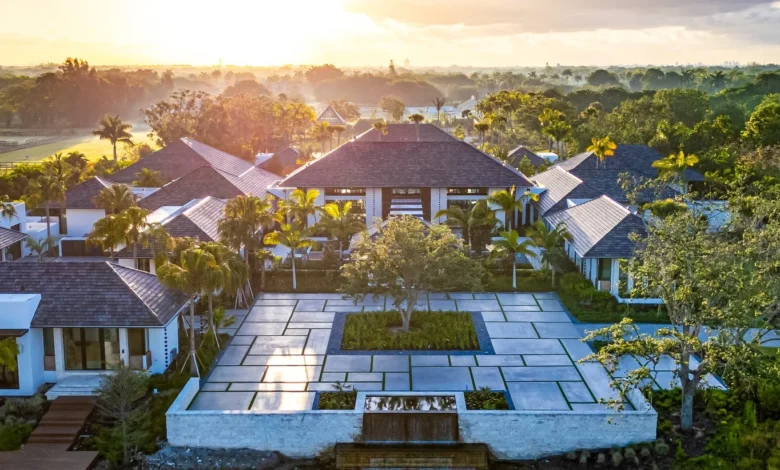
Atlantic Avenue did something unusual for a Florida downtown. Instead of resurfacing its public realm in poured concrete, Delray Beach committed to unit paving: brick and concrete paver walkways, defined crossings, planted medians and a streetscape that reads as designed rather than merely functional. Two decades on, the aesthetic has moved off the avenue and into the neighbourhoods around it.
Residential hardscape in Delray Beach now borrows heavily from that vocabulary. Front walkways are wider and pattern led. Driveways use borders and soldier courses instead of a single field. Rear patios are treated as outdoor rooms with defined edges. The shift is visible from the street, and it has changed what local homeowners expect from a contractor.
Public Streetscape as a Residential Reference Point
Municipal paving projects are designed to a standard most private work never approaches. Bases are engineered for pedestrian and occasional vehicle load, joints are specified, edge restraint is detailed and drainage is calculated rather than estimated. When residents walk that surface daily for years and watch it stay flat, it sets an expectation.
The practical consequence is that Delray Beach homeowners often arrive at their first estimate already knowing what a well built paver surface looks like after a decade. They notice joint width. They notice whether cuts at borders are clean. They notice when a neighbour’s driveway has begun to dish near the apron. That literacy tends to produce better projects, because it produces better questions.
Pattern Choices Carry Structural Consequences
Design decisions in unit paving are not purely visual. A ninety degree herringbone pattern interlocks more effectively under vehicle load than a running bond or a stack bond, which is why it remains the standard recommendation for driveways. Larger format units suit patios and pool surrounds where loads are lighter and a calmer visual field is desirable. Borders and soldier courses are not only decorative; they help terminate the field cleanly against the edge restraint.
Joint width is the other detail that separates a considered installation from a hurried one. Units laid tight to one another leave nowhere for polymeric sand to lock, while joints left too wide read as sloppy and wash out faster under heavy rainfall. The correct spacing depends on the unit and the pattern, and consistency across the whole field is what the eye actually registers from the street.
Cut quality is where craftsmanship becomes visible. Every border, step transition and door threshold requires precise cutting, and the difference between a tight cut and a gapped one shows permanently. Homeowners comparing bids are well advised to look at completed projects rather than showroom samples, because the samples never include the corners.
The Coastal Environment Sets the Maintenance Clock
Delray Beach’s proximity to the Atlantic introduces salt laden air, intense ultraviolet exposure and humidity that favours biological growth in joints. Polymeric jointing sand rated for marine conditions holds better than standard sand under those pressures, and a first seal applied after installation slows colour fade and makes routine cleaning far easier.
Local specialists build these conditions into their standard scope rather than treating them as upgrades. Craft Pavers, a licensed Palm Beach County contractor working across Delray Beach and the surrounding coastal communities, includes marine grade polymeric jointing and a complimentary first seal on full installations, an approach that reflects how quickly untreated joints degrade in this specific microclimate.
Maintenance expectations should be set at the point of sale. A sealed paver surface in Delray Beach typically wants attention every few years rather than annually, but the interval depends on shade, irrigation overspray and traffic. A contractor who declines to give a realistic figure is usually the wrong contractor.
Historic Districts Add a Layer of Review
Portions of Delray Beach sit within designated historic districts where exterior alterations, including visible hardscape, may be subject to review. Material palette, colour and pattern can all fall within scope. Separately, many of the city’s newer communities operate architectural review committees with their own approved product lists.
Neither process is onerous when it is anticipated. Both are disruptive when it is not. The homeowners who move fastest through approval are those who assemble drawings, material specifications, the contractor’s licence and a certificate of insurance before scheduling anything, and who confirm at the outset whether their property falls within a review boundary.
What the Migration From Avenue to Backyard Really Signals
The underlying story in Delray Beach is not about brick. It is about a community that saw sustained investment in its public surfaces and then applied the same standard privately. Residential hardscape budgets in the city have shifted toward better bases, better jointing and better edge detailing, because residents have a visible, walkable benchmark for what those decisions buy over time.
That is an unusually healthy dynamic for a local construction market. It rewards contractors who specify properly and it gradually squeezes out those who compete only on price. For homeowners planning a project in the city, the most useful thing to bring to a first estimate is a clear memory of the surfaces downtown that have stayed flat for twenty years, and the willingness to ask what was done underneath them.