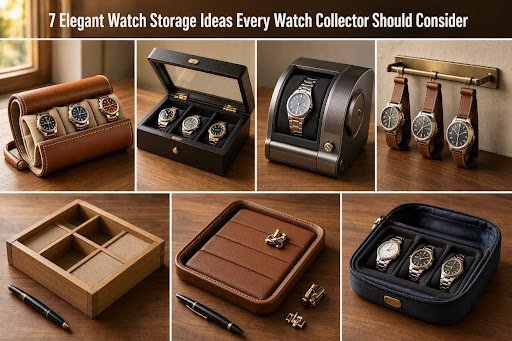
A good watch deserves more than a safe place to sit. The right storage protects a timepiece from scratches, dust, moisture, accidental knocks, and unnecessary wear. It also makes a collection easier to organise and more enjoyable to use.
Whether you own one luxury watch or a growing collection of mechanical timepieces, your storage choice can make a real difference. A watch left loose in a drawer can rub against other objects, while a poorly designed case may expose straps and polished surfaces to damage.
The good news is that you do not need a complicated setup. From traditional watch boxes to compact travel rolls, several storage options can keep watches protected while adding a refined touch to your dressing area.
Here are seven elegant watch storage ideas worth considering.
1. Choose a Quality Watch Box for Your Main Collection
A watch box remains one of the simplest and most practical ways to organise several watches in one place.
A well-designed box gives each watch its own space. This helps prevent cases, bracelets, buckles, and crystals from touching one another. It also lets you see your collection at a glance instead of searching through drawers every morning.
For collectors who own several watches, the design of the box matters almost as much as its capacity.
Look for:
- Individual compartments
- Soft watch cushions
- A secure lid
- Quality lining
- Strong construction
- Enough room for larger cases
- A design that suits your interior
The best watch box should protect your watches while still looking attractive on a shelf, desk, or dressing table.
Collectors can also explore different styles and materials before choosing the right option. Aevitas UK watch collection offers a range of watch storage solutions designed with both presentation and protection in mind.
Why a watch box works so well
The biggest advantage is organisation. Instead of keeping watches in their original packaging or separate drawers, you can create one dedicated storage area.
It also makes it easier to rotate your watches. When every piece is visible, you are more likely to wear different watches instead of reaching for the same one every day.
2. Use a Leather Watch Roll for Travel
A traditional watch box works well at home, but it is not always practical when you travel.
This is where a watch roll becomes useful.
A leather watch roll provides a compact way to carry one or more watches while keeping them separated from other items in your luggage. It takes up much less space than a large watch box and can easily fit inside a suitcase or weekend bag.
For frequent travellers, a well-made leather roll offers a useful combination of portability and style.
Aevitas’s Leather Watch Rolls are particularly suitable for collectors who want a refined travel-friendly storage option.
What makes a good watch roll?
Pay attention to the following features:
- Soft interior protection
- Secure closure
- Strong outer material
- Separate spaces for watches
- Compact dimensions
- Comfortable handling
Leather can also develop character over time, making a quality watch roll feel more personal as it ages.
For business trips, holidays, or weekend travel, a roll can protect your watches without adding unnecessary bulk.
3. Consider a Display Box for a More Luxurious Setup
Some collectors want storage to do more than protect their watches. They want it to become part of the room.
A display-style watch box can achieve this.
Instead of hiding your collection inside a drawer, a display box allows you to appreciate the watches when they are not on your wrist. A glass or transparent top can make the box feel more like a miniature showcase.
This approach works particularly well when your collection includes watches with distinctive dials, unusual complications, or sentimental value.
However, display storage requires some care.
Avoid placing the box somewhere exposed to strong direct sunlight for long periods. Excessive sunlight can affect certain materials and may gradually alter the appearance of some watch components, straps, or finishes.
A cool, dry location away from harsh sunlight is usually a better choice.
4. Explore Watch Storage Designs from Different Cultures
Watch storage does not have to follow one standard design.
Different regions and design traditions have influenced the way people present and protect valuable watches. Collectors can find inspiration in traditional boxes, modern minimalist cases, handcrafted wooden designs, leather storage, and contemporary display systems.
Looking at different approaches can help you find a storage style that matches your own collection.
For example, a collector with classic Swiss watches may prefer traditional materials and understated detailing. Someone with modern sports watches might prefer a cleaner, contemporary case.
The storage itself can become part of the collector’s personality.
If you enjoy exploring unusual designs, Discovering Unique Watch Box Designs Around the World provides useful inspiration for looking beyond conventional storage styles.
Storage can reflect your collection
A watch collection often grows around personal taste. The same idea can apply to storage.
You might prefer:
- Traditional leather
- Minimalist modern designs
- Natural wood
- Carbon-fibre details
- Classic luxury styling
- Compact travel solutions
There is no single perfect style. The important thing is to choose storage that protects the watches and suits the way you use them.
5. Give Every Watch Its Own Space
One of the most important storage principles is simple: avoid letting watches touch each other.
Luxury watches often feature polished cases, sapphire crystals, ceramic bezels, precious metals, or carefully finished bracelets. Even when two watches look harmless sitting together, movement inside a drawer or box can create unwanted contact.
Separate compartments reduce this risk.
The same principle applies to straps and buckles. A metal buckle pressing against another watch can leave marks over time.
If you already own a collection, check how your current storage works.
Ask yourself:
- Does every watch have its own compartment?
- Are the cushions soft enough?
- Do larger watches fit comfortably?
- Can bracelets rest without pressure?
- Does anything rub against the crystal or case?
If the answer to any of these questions is no, upgrading your storage may be worthwhile.
6. Create a Dedicated Watch Corner at Home
You do not need an entire room for your collection.
A small, organised watch corner can provide an effective storage area while making your morning routine easier.
A dressing table, wardrobe shelf, cabinet, or desk can work well. The key is to keep the area clean, dry, and away from unnecessary clutter.
You can combine different storage types depending on your collection.
For example:
At home: Use a watch box for your main collection.
For travel: Keep one or two watches in a compact watch roll.
For special pieces: Use a dedicated display compartment.
For accessories: Keep spare straps, tools, and other watch-related items separate from the watches themselves.
This creates a simple system that makes the collection easier to manage.
Keep storage away from unnecessary hazards
Avoid storing watches beside sinks, open windows, radiators, or areas where they may be knocked over.
Humidity also deserves attention. While a watch’s water resistance protects it under specific conditions, that does not mean you should deliberately expose it to damp storage environments.
Storage should support the watch’s condition rather than create new risks.
7. Match Your Storage to the Type of Watch You Own
Not every watch needs exactly the same storage solution.
A dress watch, diving watch, vintage watch, and travel watch may all benefit from slightly different approaches.
Dress watches
Dress watches often have slimmer profiles and elegant straps. A soft-lined compartment can keep them secure without placing unnecessary pressure on the strap.
Sports watches
Sports watches can have larger cases and bracelets. Make sure the compartment provides enough space so the watch does not press against the lid or neighbouring pieces.
Vintage watches
Vintage watches deserve extra care because older materials and components may be more sensitive to environmental conditions. Gentle storage and careful handling become particularly important.
Automatic watches
Automatic watches contain mechanical movements that rely on intricate components working together. Professional watchmakers use specialised procedures to inspect, clean, lubricate, and adjust these movements. The British Horological Institute provides detailed training resources covering automatic watch servicing and mechanical watch care.
For this reason, storage should be viewed as part of a wider care routine rather than a replacement for professional servicing.
How Should You Store an Automatic Watch?
An automatic watch can usually remain safely stored when it is not being worn. You do not need to keep it running simply because it has an automatic movement.
If the watch stops, you can follow the manufacturer’s instructions for winding and setting it before wearing it again.
The bigger priority is protecting the watch from unnecessary physical damage, moisture, extreme conditions, and poor handling.
A suitable watch box or roll can help keep the watch secure while it is resting.
Do You Need a Watch Winder?
A watch winder can be useful in certain situations, particularly for collectors who own automatic watches with complicated calendars or functions that take time to reset.
However, not every automatic watch requires a winder.
If you are comfortable resetting your watch after it stops, traditional storage may be all you need. A quality watch box can protect a non-running automatic watch perfectly well.
A winder therefore works best as a convenience rather than an automatic requirement for every collector.
Watch Box vs Watch Roll: Which Should You Choose?
The right option depends mainly on where and how you use your watches.
| Feature | Watch Box | Watch Roll |
| Best use | Home storage | Travel |
| Capacity | Usually higher | Usually lower |
| Portability | Limited | Excellent |
| Display | Excellent | Limited |
| Organisation | Excellent | Very good |
| Space required | More | Less |
| Style | Classic and decorative | Compact and refined |
If you keep most of your collection at home, a watch box makes sense.
If you travel regularly, a leather watch roll provides a more convenient solution.
Many serious collectors eventually use both.
How to Build a Simple Watch Storage System
You do not need to buy everything at once.
Start by identifying how many watches you own and how often you travel.
If you own three or four watches and rarely travel, begin with a compact box.
If you travel frequently, consider adding a watch roll.
As your collection grows, upgrade the storage rather than allowing watches to become scattered across drawers and cabinets.
A simple system could look like this:
Step 1: Keep your everyday watches in a quality watch box.
Step 2: Store travel watches in a dedicated roll.
Step 3: Keep valuable documents and accessories in a separate organised area.
Step 4: Check your watches regularly for signs of wear or damage.
Step 5: Arrange professional servicing when your watch manufacturer or qualified watchmaker recommends it.
This approach keeps your collection organised without making watch ownership unnecessarily complicated.
Common Watch Storage Mistakes to Avoid
Even an expensive watch can suffer from poor storage habits.
Leaving watches loose in a drawer
Loose watches can move around and come into contact with other objects.
Overcrowding a watch box
A box with too many watches defeats the purpose of individual compartments. Give each watch enough room.
Storing watches in damp areas
Bathrooms and other humid areas are generally poor choices for long-term watch storage.
Ignoring the strap
The movement is not the only part worth protecting. Leather straps can also suffer from moisture, pressure, and poor storage.
Keeping everything in original packaging
Original boxes can be useful, but they are not always the most practical everyday storage solution, especially if they are bulky.
Choosing appearance over protection
A beautiful storage box is not useful if its interior does not protect the watches properly.
The best storage combines both qualities.
How Often Should You Check Your Stored Watches?
You do not need to inspect your collection every day.
However, regular checks can help you notice problems early.
Look for:
- Dust or debris
- Strap deterioration
- Scratches
- Moisture
- Loose components
- Signs of corrosion
- Unusual changes in the watch’s operation
If something seems wrong, avoid trying to repair a valuable mechanical watch yourself unless you have the appropriate skills and tools. Professional watchmakers use specialised equipment and procedures when servicing mechanical movements.
Good storage reduces everyday risks, but it cannot replace proper maintenance.
Final Thoughts
The best watch storage solution depends on your collection, lifestyle, and personal taste.
A quality watch box works particularly well for home storage because it keeps watches separated, organised, and easy to access. A leather watch roll makes more sense when you need compact protection while travelling. Display boxes can turn a collection into part of your interior, while dedicated storage areas help keep everything organised.
The most important principle is simple: store your watches in a way that protects them from unnecessary contact, moisture, dust, and accidental damage.
As your collection grows, your storage can grow with it. Choosing the right combination of watch boxes, rolls, and dedicated spaces allows you to protect your watches while enjoying them every day.
FAQs
1. What is the best way to store luxury watches?
A quality watch box with individual, soft-lined compartments is one of the best options for home storage. It keeps watches separated and protects them from unnecessary contact.
2. Are leather watch rolls good for watches?
Yes. A well-made leather watch roll can provide compact protection and works especially well for travel. Choose one with a soft interior and secure compartments.
3. Should automatic watches be kept in a watch winder?
Not necessarily. A watch winder can provide convenience, but most automatic watches can simply be stored and reset when you want to wear them.
4. Can I store watches in a drawer?
You can, but loose storage is not ideal. Watches can move around and come into contact with other objects. A dedicated box or roll provides better protection.
5. Where should I avoid storing my watches?
Avoid areas with excessive moisture, strong direct sunlight, extreme temperatures, or a high risk of accidental knocks. A cool, dry and secure location is generally better.
6. Should every watch have its own compartment?
Ideally, yes. Individual compartments reduce the chance of watches touching one another and help protect polished cases, crystals, bracelets, and buckles.
7. Is a watch box better than a watch roll?
Neither is universally better. A watch box usually works better at home, while a watch roll offers greater portability for travel. Many collectors use both.
8. How should I store vintage watches?
Vintage watches deserve gentle handling and a clean, dry storage environment. Avoid overcrowding them and consider professional advice if you notice deterioration or mechanical problems.
9. Does proper storage replace watch servicing?
No. Good storage protects a watch from everyday environmental and physical risks, but mechanical watches still require appropriate maintenance and servicing. Professional horology resources such as the British Horological Institute provide detailed information on mechanical and automatic watch servicing. British Horological Institute watch servicing resources