A good power bank can solve a surprising number of problems. It can keep a phone alive on a train journey, recharge wireless earbuds and give a camera enough power to finish the day. For everyday commuting or a short city break, that may be all you need.
A power station solves a different problem. Instead of carrying a little extra energy for one or two USB devices, it provides a much larger battery that can support several people, laptops, camera equipment and, depending on the model, appliances that normally need a mains socket.
The point is not that a power station is always better. It is knowing when a power bank has stopped being the practical option.
Start with energy, not the size of the battery pack
Power banks are commonly marketed by milliamp-hours, such as 10,000mAh or 20,000mAh. That figure is useful when comparing similar power banks, but it does not translate directly into the watt-hours quoted for larger energy-storage products unless battery voltage is also considered.
For real-world planning, watt-hours are easier to understand because they describe stored energy.
A power station with around 1,000Wh contains a very different amount of usable energy from a normal pocket-sized power bank. It is designed not merely to top up a phone, but to act as a shared energy source for a collection of devices.
That distinction matters more than whether the battery physically looks large.
When a power bank is still the sensible choice
For one person carrying a phone, earbuds and perhaps a small camera, a power bank remains difficult to beat.
It fits into a backpack, requires almost no planning and can be recharged easily in a hotel or at home. If the only goal is keeping a smartphone running until the evening, carrying several kilograms of battery would make little sense.
A power bank is therefore usually enough for:
- commuting and day trips;
- a single phone or tablet;
- topping up earbuds or a smartwatch;
- occasional camera charging;
- travel where mains power is available every night.
The situation changes once several of these requirements begin to overlap.
The first reason to step up: several people need power
A weekend away with four people can turn one simple charging problem into eight or ten.
There may be four phones, two cameras, wireless microphones, smartwatches, a speaker and a laptop. Even if none of those devices consumes much power individually, they compete for both energy and charging ports.
This is where a power station starts to make more sense. Instead of everyone carrying separate power banks and chargers, one larger battery can become the central charging point for the group.
It is particularly useful at a campsite, festival base, holiday cottage without convenient sockets or a van where devices return to the same place between activities.
Laptops are often the turning point
Phones are easy to keep alive. Laptops change the calculation.
A modern USB-C laptop may require 60W, 100W or even more while charging. A large USB power bank can handle some models, but once two laptops, cameras and phones need power at the same time, a small battery quickly becomes restrictive.
A power station also gives you much greater energy capacity rather than simply a more powerful USB port.
For remote work, photography trips and video production, that difference is important. The question is no longer, “Can this battery charge my laptop once?” It becomes, “Can it keep my work setup going for the weekend?”
AC devices are the clearest sign that a power bank is no longer enough
The biggest functional difference is access to mains-style AC power.
A conventional power bank is built primarily around USB devices. A power station can also run compatible equipment that normally plugs into a wall socket, provided its power requirement stays within the station’s output limits.
That could include certain cool boxes, monitors, lights, projectors or other equipment used around a campsite or van.
Maximum output and battery capacity must still be separated. A station capable of delivering 1,000W does not contain 1,000Wh automatically, and being able to operate a powerful appliance does not mean it can operate it for hours.
High-power heating and cooking equipment can empty even a large battery surprisingly quickly.
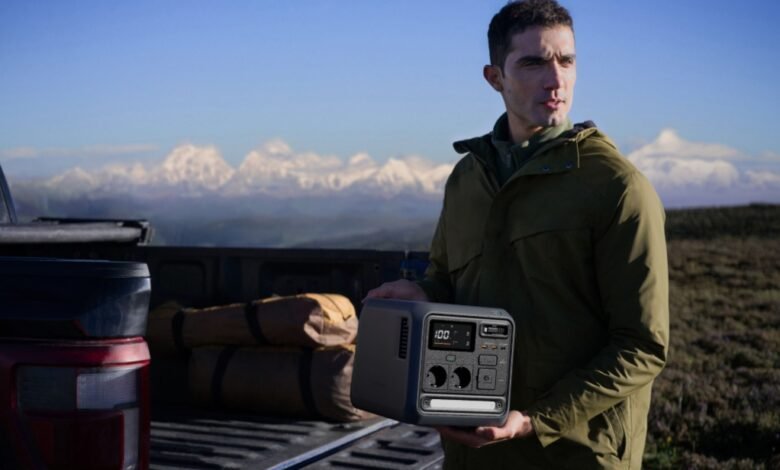
DJI Power 500 is a practical first step beyond power banks
For users who need substantially more energy but still care about portability, the DJI Power 500 occupies a useful middle ground.
It offers 512Wh capacity and up to 1,000W maximum continuous output while weighing approximately 7.3kg. That is already a significant jump from a normal power bank, but it remains easier to carry than a full 1kWh-class station.
This makes it suitable for a photography day, a small camping setup or a workspace where phones, cameras, a laptop and lighting need to share one battery.
Its size also illustrates an important point: moving to a power station does not necessarily mean buying the largest model available. The right step depends on how many devices need power and how long you expect to stay away from a socket.
DJI Power 1000 Mini suits longer weekends
When a trip extends beyond one day, the current DJI Power 1000 Mini becomes especially interesting.
It has a typical capacity of 1,008Wh while weighing approximately 11.5kg. For the UK version, DJI specifies up to 1,000W maximum AC output, with 800W rated continuous output.
The useful part for everyday electronics is the connectivity. It includes two AC outlets, two USB-A ports, a USB-C port and an integrated retractable USB-C cable.
The USB-C port and retractable cable can each deliver up to 100W individually. When used together, DJI specifies a combined USB-C output of up to 150W.
For a weekend away, that means a laptop can charge while phones, cameras and smaller devices use the remaining connections. The built-in cable also reduces the chance that the one cable everyone needs has been left at home.
Why roughly 1kWh changes the way you plan a trip
At this capacity, the battery becomes less about emergency charging and more about energy management.
You can recharge several devices repeatedly rather than deciding which phone gets the final power-bank top-up. A camera setup can be recharged between shoots. A laptop can be used for editing in the evening. Small campsite electronics can share the same energy source.
The Power 1000 Mini also supports different recharging options within the DJI Power ecosystem, including grid, vehicle and solar solutions.
That matters on longer trips because a power station does not have to be treated as a battery that is charged only before leaving home. In a van or at a longer campsite stay, recharging can become part of the travel routine.
When Power 1000 V2 is worth the extra weight
The DJI Power 1000 V2 has a similar capacity at 1,024Wh, so choosing it over the Power 1000 Mini is not primarily about gaining more stored energy.
The difference is power and connectivity.
DJI specifies up to 2,600W continuous output under its defined conditions, substantially increasing the range of equipment that can be powered. It also has two USB-C ports capable of up to 140W each, giving a combined maximum of 280W.
That makes the Power 1000 V2 a better fit for users running high-performance laptops, production equipment or more demanding AC devices.
It weighs approximately 14.2kg, compared with around 11.5kg for the Power 1000 Mini. If the station has to be carried from a car to a campsite, the Mini has an obvious advantage. If it spends most of its time inside a van, studio base or fixed camp, the higher output of the V2 becomes easier to justify.
Do not upgrade just because the numbers are bigger
A power station is not an automatic replacement for every power bank.
If you spend one night away and only need to charge a phone, a large battery is unnecessary weight. Even the most capable station is less convenient than something that fits into a coat pocket.
The upgrade begins to make sense when at least one of three things happens: more people need to share power, devices such as laptops significantly increase energy consumption, or equipment requires AC power rather than USB alone.
Trip length matters as well. A 20,000mAh power bank might be perfectly adequate for a day. A multi-day van trip with cameras, laptops and several phones is a completely different energy problem.
Choose the smallest system that comfortably covers the job
For light personal use, stay with a power bank.
If you need a central battery for a modest camera, laptop or camping setup, the DJI Power 500 provides a relatively compact entry into proper power-station territory.
For longer weekends and groups with several USB devices, the Power 1000 Mini offers a particularly useful balance of approximately 1kWh capacity and manageable weight.
When the requirement expands from “keep everything charged” to “run demanding equipment as well”, the Power 1000 V2 adds far more AC and USB-C output without moving into a completely different capacity class.
That is the real difference between a power bank and a power station. The point to step up is not when your phone needs a bigger battery. It is when your entire trip starts depending on one reliable source of power.