Most scans show you where it hurts. An EOS scan shows you why it hurts.
If you have spent months living with back pain, postural problems, or persistent hip and knee discomfort that no MRI or X-ray has explained, you are not imagining it. The issue is often not with you — it is with the type of scan being used. Traditional diagnostic imaging captures your body lying flat, in a position it was never designed to function in. The EOS scan does something entirely different, and for many patients, it finally delivers the answers they have been looking for. ScanAlign is one of the UK’s leading specialist centres offering this technology privately, without the need for a GP referral.
What Is an EOS Scan?
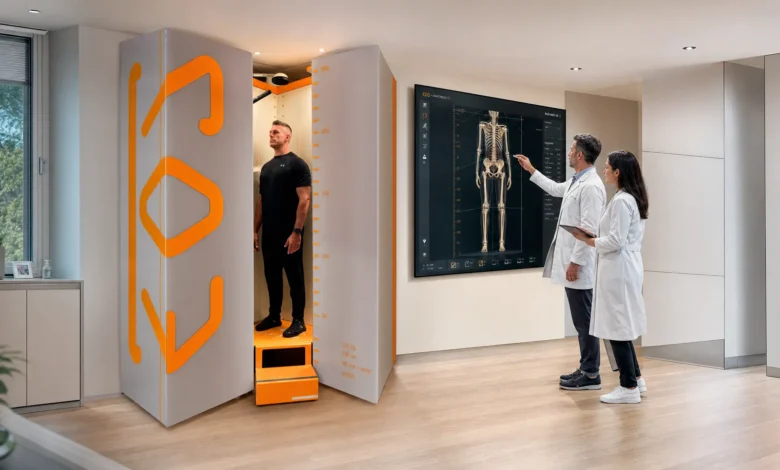
An EOS scan is a low-dose, full-body medical imaging technology that captures your entire skeleton while you stand upright. You stand inside a scanning cabin while two ultra-fine X-ray beams simultaneously capture a front-facing and side-facing image of your full skeleton in a single pass. Advanced software then builds a precise three-dimensional model of your entire musculoskeletal system from those two images.
That 3D scan is what sets EOS apart. It does not show one joint in isolation it shows how your spine, pelvis, hips, knees, and ankles all relate to each other, in the position your body actually lives in. Key advantages at a glance:
- Full skeleton captured from head to foot in one scan
- Front and side views taken simultaneously no shifting between exposures
- 3D model of your entire posture built from a single 15-second scan
- Approximately 90% less radiation than a standard X-ray
- Total appointment time under two minutes
How EOS Scanning Works — Step by Step
The process is simple. You step into an open, upright scanning cabin no tunnel, no enclosed space, nothing claustrophobic. You stand naturally while the EOS medical scanner 3D system works in around 15 seconds. Because both images are captured simultaneously, the 3D reconstruction is a perfectly accurate picture of how your skeleton aligns under gravity.
The full patient journey follows four clear steps:
- Step 1 — Free video consultation: A specialist reviews your symptoms, history, and any previous scans
- Step 2 — In-person scan: You attend the imaging centre and stand in the cabin for around two minutes total
- Step 3 — Radiologist report: A consultant radiologist reviews your images and produces a detailed written report
- Step 4 — Doctor-led follow-up: A clinician walks you through every finding and discusses next steps
There is no preparation required, no contrast injection, and no recovery time.
EOS Scan vs. MRI, X-Ray, and CT Scan
The core problem with standard imaging is position. When your body is horizontal, your skeleton relaxes, joints decompress, and any misalignment disappears from the image. This is why so many patients are told their scan looks normal it was taken in a position that removes the very stress causing the problem. EOS captures your skeleton standing, under real gravitational load. The table below shows how it compares:
EOS is not a replacement for every scan MRI remains the right tool for disc injuries and nerve issues, and CT suits emergency bone detail. But for assessing how your skeleton aligns under real load, EOS stands alone within diagnostic imaging.
What Conditions Can an EOS Scan Detect?
The weight-bearing, full-body nature of EOS makes it effective at identifying conditions that conventional medical scanning frequently misses:
- Scoliosis, kyphosis, and lordosis — Spinal curvature is far more accurately measured standing. The Cobb angle used by surgeons to assess deformity is captured with high precision from EOS images
- Pelvic tilt and hip imbalance — A tilted pelvis affects everything above and below it. Without a standing scan, this asymmetry is easy to miss entirely. EOS is particularly valuable for patients considering or recovering from hip replacement, where precise alignment data is critical
- Leg length discrepancy — Even a few millimetres of difference places chronic stress on the hips, knees, and lower back over time
- Knee misalignment — Knock knees, bow legs, and rotational problems show clearly because EOS captures the knee within the full skeletal context
- Chronic pain with no clear cause — When every other form of medical imaging comes back clear, EOS often reveals the structural root cause that has remained invisible
Who Should Get an EOS Scan?
EOS scanning is not only for people in severe pain or those already diagnosed with a spinal condition. It is for anyone who wants a genuinely accurate picture of what is happening inside their body. The clearest candidates are:
- Adults with chronic back, hip, or knee pain that has not responded to treatment
- Children and teenagers monitored for scoliosis, where ultra-low radiation makes repeated medical scanning far safer
- Patients who have received inconclusive MRI or X-ray results and are still searching for answers
- Anyone preparing for orthopaedic surgery who needs a precise 3D anatomical picture for pre-surgical planning
- Athletes looking to identify postural imbalances before they become injuries
- People who sit for long hours and have developed unexplained neck, back, or shoulder tension
EOS is also used proactively as a structural health check to catch misalignment before it causes long-term damage.
EOS Scan for Children — Why Lower Radiation Matters
For parents of children with scoliosis, radiation exposure is a genuine concern. Scoliosis often requires imaging every few months over several years, meaning the cumulative burden of repeated standard X-rays becomes a real clinical issue. EOS changes that. Research shows it delivers approximately 5.4 times less radiation than conventional full-spine X-rays for paediatric patients. A dedicated paediatric EOS scanning pathway ensures children receive age-appropriate care throughout the process. For children specifically:
- Dramatically lower radiation per scan compared to standard X-ray
- No repositioning needed between front and side images both captured at once
- The open cabin is far better tolerated than MRI tunnels by younger patients
- Results reflect how the spine actually behaves in daily life, not just lying still
What to Expect During Your EOS Scan Appointment
The patient journey is designed to be straightforward and informative. It starts with a free video consultation where a specialist reviews your symptoms, history, and any previous imaging. No GP referral is required patients self-refer directly, making this faster than traditional imaging pathways.
If you proceed, you attend an in-person appointment where the scan takes around two minutes. A consultant radiologist then produces a full structural report, and a doctor-led follow-up explains every finding clearly. The patient support team is also available throughout your journey to answer questions and help coordinate your care.
Conclusion
Living with unexplained pain is exhausting, especially when every scan comes back clear. EOS scanning changes that by showing your skeleton exactly as it functions in real life under real load, in a single two minute appointment.
For anyone stuck in a cycle of inconclusive results and treatments that do not hold, EOS finally offers a complete, accurate picture of what is actually going on inside your body.
Get Clear Answers with an EOS Scan
Book your free video consultation today and see what your spine, hips, knees, and posture reveal under real weight.
FAQs
What is an EOS scan used for?
EOS assesses spinal conditions such as scoliosis, kyphosis, and lordosis; pelvic and hip imbalance; leg length discrepancy; knee misalignment; and chronic pain unexplained by standard imaging.
Is an EOS scan the same as a 3D scan?
EOS produces both 2D and 3D images from a single scan. The 3D reconstruction from simultaneous front and side images is one of its core advantages over conventional X-rays.
Is EOS scanning safe for children?
Yes. EOS uses approximately 90% less radiation than a standard X-ray ideal for children requiring repeated monitoring over time.
How is EOS different from an MRI?
MRI is taken lying down, allowing the skeleton to relax and hiding misalignment. EOS is taken standing under gravity, revealing what MRIs frequently miss.
Do I need a GP referral for an EOS scan?
No. Patients self-refer directly. A free video consultation is the first step.
Can EOS scanning replace a CT scan?
For weight-bearing skeletal assessment, EOS is often a superior, lower-radiation alternative. CT remains appropriate where cross-sectional or emergency bone detail is needed.