Video is no longer a special format that teams use only for major launches. It has become part of everyday communication for brands, educators, agencies, online retailers and creators.
A product update may need a short demo. A training team may need a visual explanation. A social campaign may need several versions before the strongest idea becomes clear. Even internal announcements are becoming more visual because people are used to receiving information through short clips.
The pressure is simple: more teams need more video, more often.
The problem is that video production has not always matched that pace. Even a short clip can involve scripting, selecting visuals, editing, sound, approval and multiple rounds of revision. For companies with full creative departments, that process may be manageable. For small teams, lean agencies or growing ecommerce brands, it can become a bottleneck.
This is why AI video workflows are becoming part of modern content operations. The most practical use is not replacing production teams or removing creative judgement. It is helping teams get to a first usable draft faster, so they can test ideas before spending more time and budget.
Content teams are under more pressure
The demand for video has grown because audiences now expect motion in places where static content used to be enough.
Product pages often perform better with short visual explainers. Social platforms reward clips that communicate quickly. Online courses need clearer demonstrations. SaaS companies use video to explain features that would otherwise require long documentation. Retailers want product images to feel more alive.
At the same time, content teams are expected to work faster. A campaign that once needed one hero video may now need versions for Instagram, TikTok, YouTube Shorts, website banners, ads, newsletters and sales presentations.
That does not mean every video should be complex. Many useful clips are short, simple and focused. The challenge is making them quickly without losing control over the message.
Why the first draft matters
In many teams, the slowest part of video creation is not the final polish. It is getting from idea to first draft.
A marketer may know the message but not the exact visual sequence. A founder may have product screenshots and a rough script but no time to build a polished explainer. An educator may have the lesson written but need a short video to make it easier to understand.
AI video helps at this early stage because it turns direction into something visible. A team can start with a prompt, a product image, a reference frame or a short audio file and produce a draft that people can watch, discuss and improve.
That draft may not be final. It does not need to be. Its value is that it gives the team a clearer object to react to than a written brief or a static storyboard.
Asset-guided creation is becoming more useful
One reason early AI video tools felt limited was that they often relied too heavily on text prompts. A text prompt can describe an idea, but real content work usually begins with existing materials.
Teams already have product photos, brand visuals, campaign copy, lesson notes, voice recordings, customer explainers, moodboards and previous content. Those assets carry context that a prompt alone may miss.
Asset-guided creation changes the workflow. Instead of asking a model to invent everything from text, teams can use images, audio or reference material to guide the output. That makes the process more practical for commercial content, where consistency matters.
For example, an ecommerce team may want a product to remain recognizable. A SaaS team may want a video to match the design language of its app. A training team may need the motion to support narration rather than distract from it. In each case, the video works better when the tool understands the source material.
Video is becoming a planning tool
For many organisations, AI video is most useful before full production begins.
A short draft can help a team choose between creative directions. It can show whether a product story makes sense in motion. It can help stakeholders understand a concept before approving a larger campaign. It can also reduce unclear handoffs between strategy, design and editing.
This turns video into a planning tool, not only a publishing format.
Agencies can use quick drafts to discuss campaign tone with clients. Educators can test whether a lesson sequence is clear. Ecommerce teams can compare product scenes before choosing one for ads. Social teams can test whether a concept works in portrait format before building a full content set.
The result is a more flexible creative process. Teams can explore ideas visually without treating every test as a finished production.
Control still matters
Speed alone is not enough.
Commercial video needs structure, accuracy and brand fit. A clip that looks attractive but misunderstands the product or message can create more work than it saves. This is why control features matter in AI video workflows.
Start and end points are especially important. A brand may want a product to appear clearly at the beginning and finish. A training video may need to move from a problem to a solution. A social clip may need a clear opening frame so viewers understand the message immediately.
Audio also changes the quality of a short video. Narration, music and sound can make a clip feel more complete, but they also require careful handling. Businesses should use approved scripts, licensed music and appropriate voice material. Faster creation should still include human review.
Wan 2.7 as a practical example
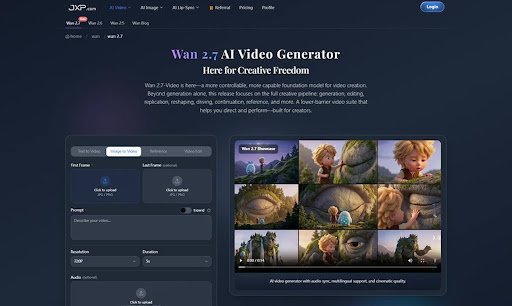
One example of this shift is Wan 2.7, an AI video generator built for text-to-video, image-to-video, reference video and editing workflows.
Its features reflect how modern teams actually work. Users can begin with text, images, first and last frames, optional audio or reference material, then refine results through the same workflow. That makes it more suitable for teams that need drafts, variations and controlled video outputs rather than one-off experiments.
For a marketing team, this could mean turning a product image into a short campaign concept. For an educator, it could mean creating a visual explanation from a lesson outline. For an agency, it could mean showing a client several directions before committing to a larger production.
The useful part is not only generation. It is the ability to keep adjusting the result when the first draft is close but not finished.
Where teams can start
Teams do not need to rebuild their entire content process to use AI video. A simple approach is usually better:
- Define the goal of the video before writing the prompt.
- Choose approved images, audio or reference material.
- Use first and last frames when the clip needs a clear structure.
- Keep the first draft short.
- Review the result for accuracy, motion, brand fit and audio.
- Use editing instructions to improve the strongest version.
- Approve the final clip before publishing.
This keeps AI video connected to real communication needs. The tool helps create and refine, but people still decide whether the result is clear, accurate and suitable for the audience.
For teams that already produce regular digital content, an AI video generator can reduce the gap between an idea and a draft. That gap is often where good concepts slow down.
The next stage of everyday video
AI video will continue to improve, with better motion, stronger audio sync, clearer editing and more reliable visual control. But the bigger shift is operational.
Video creation is becoming easier to include in everyday workflows. A marketing manager, educator, founder or content creator can now test ideas that previously required more production support. This does not remove the need for creative skill. It gives more people a way to start.
That is why text to video AI is becoming relevant beyond experimental content. It helps teams turn existing assets, scripts and ideas into something visible before the opportunity has passed.
For modern content operations, the goal is not simply to make more video. The stronger goal is to make better decisions earlier, with drafts that are fast enough to test and controlled enough to be useful.