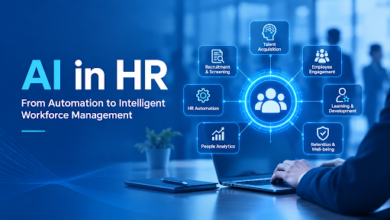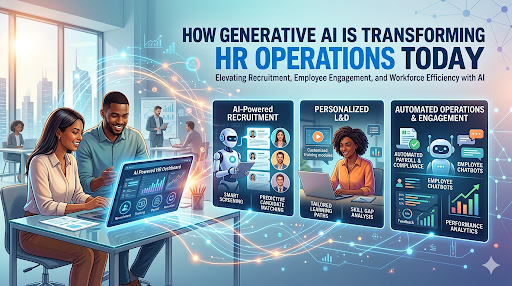
Generative AI is rapidly becoming a strategic priority for human resources leaders seeking to improve efficiency, enhance employee experience and drive data-informed decision-making. As organizations navigate evolving workforce expectations and increasing operational complexity, HR functions are under pressure to deliver more value with fewer resources.
Unlike traditional automation, generative AI enables HR teams to create content, generate insights and augment decision-making in real time. From talent acquisition to employee engagement, its applications are expanding quickly. However, realizing its full potential requires a structured, research-driven approach aligned with enterprise strategy and governance.
Overview Of Gen AI In HR
Generative AI refers to advanced artificial intelligence models that can create text, analyze data patterns and produce recommendations based on large datasets. In HR, this capability is transforming how organizations manage talent, streamline operations and improve workforce planning.
Public insights from The Hackett Group® indicate that leading organizations are leveraging AI to enhance productivity while maintaining a strong focus on governance and compliance. Rather than replacing HR professionals, generative AI augments their capabilities by automating repetitive tasks and enabling more strategic contributions.
Within HR functions, generative AI can support:
- Drafting job descriptions and candidate communications
- Summarizing employee feedback and engagement surveys
- Generating workforce analytics reports
- Assisting with policy documentation
- Enhancing learning and development content
Organizations adopting AI-driven HR models are increasingly aligning these initiatives with broader digital and transformation strategies. This ensures consistency, scalability and measurable outcomes across the enterprise.
Benefits Of Gen AI In HR
1. Increased productivity and operational efficiency
Generative AI significantly reduces manual effort in routine HR activities such as document creation, candidate screening and reporting. By automating repetitive processes, HR teams can focus on strategic priorities such as talent development and workforce planning.
2. Improved employee experience
AI-powered tools can deliver personalized communication, faster responses to employee queries and more relevant learning recommendations. This improves engagement and satisfaction across the employee lifecycle.
3. Enhanced decision-making
Generative AI can analyze large volumes of workforce data and generate insights that support better decision-making. HR leaders can use these insights to optimize hiring strategies, retention programs and organizational design.
4. Cost optimization
By streamlining processes and reducing manual workloads, generative AI helps organizations lower operational costs. It also minimizes errors and rework, contributing to overall efficiency gains.
5. Stronger compliance and risk management
HR functions must adhere to regulatory requirements and internal policies. Generative AI can assist in drafting compliant documentation and identifying potential risks in workforce data and processes.
Use Cases Of Gen AI In HR
1. Talent acquisition and recruitment
1.1 Automated job description creation
Generative AI can draft compelling and consistent job descriptions based on role requirements and organizational standards. This ensures alignment across hiring processes and improves candidate attraction.
1.2 Resume screening and candidate matching
AI models can analyze resumes, match candidates to job requirements and rank applicants based on predefined criteria. This reduces time-to-hire and improves hiring quality.
2. Employee engagement and communication
2.1 Personalized communication
Generative AI enables HR teams to create tailored communication for employees based on role, location and preferences. This enhances engagement and ensures messaging is relevant.
2.2 Survey analysis and sentiment insights
AI can analyze employee feedback and generate summaries that highlight key trends and concerns. This helps HR leaders take proactive action to improve workplace culture.
3. Learning and development
3.1 Content generation for training programs
Generative AI can create learning materials, training modules and knowledge resources tailored to specific roles and skill levels.
3.2 Personalized learning paths
AI-driven insights can recommend customized learning journeys based on employee performance, career goals and organizational needs.
4. Workforce planning and analytics
4.1 Predictive workforce insights
Generative AI can analyze historical data to forecast workforce trends, including attrition risks and future skill requirements.
4.2 Organizational design support
AI can generate recommendations for optimizing team structures and resource allocation based on business objectives.
5. HR operations and policy management
5.1 Policy drafting and updates
Generative AI can assist in creating and updating HR policies, ensuring consistency and alignment with regulatory standards.
5.2 Knowledge management
AI-powered assistants can provide instant access to HR policies and procedures, improving response times and reducing dependency on manual support.
Why Choose The Hackett Group® For Implementing Gen AI In HR
Implementing generative AI in HR requires more than adopting new technologies. It demands a structured, benchmark-driven approach that aligns with business strategy and delivers measurable results. The Hackett Group® provides this foundation through its research-backed methodologies and transformation expertise.
1. Benchmark-driven insights and strategy
The Hackett Group® leverages extensive benchmarking data to help organizations identify performance gaps and prioritize high-impact AI use cases. This ensures that investments are aligned with business value rather than isolated experimentation.
Organizations looking to build a structured roadmap can benefit from AI Strategy Consulting, which aligns AI initiatives with enterprise objectives and operational goals.
2. Governance and risk management framework
Generative AI introduces new challenges related to data privacy, compliance and ethical use. A strong governance framework ensures that AI adoption is responsible, secure and aligned with regulatory requirements.
3. Integrated transformation approach
Rather than treating AI as a standalone initiative, The Hackett Group® integrates generative AI into broader transformation programs. This approach ensures scalability, consistency and long-term sustainability.
4. Practical implementation and scaling
From identifying use cases to executing pilot programs and scaling solutions, organizations receive practical guidance based on real-world experience. This includes change management, capability building and operating model alignment.
To understand how AI is being applied across enterprise functions, including HR, organizations can explore insights into Gen AI in HR that highlight practical applications and emerging trends.
The Hackett AI XPLR™ platform further supports organizations by enabling leaders to explore, prioritize and implement AI use cases in a structured and value-driven manner.
Conclusion
Generative AI is transforming HR from a transactional function into a strategic driver of business value. By automating routine tasks, enhancing decision-making and improving employee experience, it enables HR teams to operate more efficiently and effectively.
However, achieving these benefits requires a disciplined approach that aligns technology adoption with business strategy, governance and measurable outcomes. Organizations must focus on integrating generative AI into core HR processes while maintaining compliance and ethical standards.
As the technology continues to evolve, HR leaders who adopt a structured and research-driven approach will be better positioned to realize its full potential. Generative AI is not just a technological advancement. It is a strategic enabler that empowers HR to deliver greater impact across the enterprise.