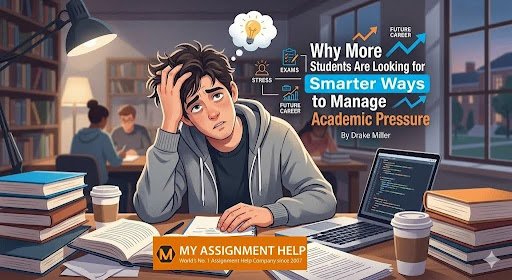
In the modern educational landscape, the stakes have never been higher. From the bustling hallways of UK secondary schools to the historic lecture theatres of Russell Group universities, a common thread unites students: the search for smarter, more efficient ways to handle an ever-increasing academic load.
The traditional “burn the midnight oil” approach is being replaced by a more strategic, tech-savvy, and well-being-focused methodology. This shift isn’t just about getting better grades; it’s about surviving and thriving in a hyper-competitive global environment where “output over hours” is becoming the new gold standard.
The Evolution of Academic Pressure in the UK
Academic pressure is not a new phenomenon, but its nature has evolved significantly over the last decade. For high school students in the UK, the transition from GCSEs to A-Levels represents a jarring jump in analytical depth. It is no longer enough to memorize facts; examiners now look for high-level synthesis and critical evaluation.
For university students, the pressure is compounded by the rising cost of tuition and a saturated graduate job market. The internal desire to achieve a First-Class degree is often driven by the knowledge that top-tier graduate schemes in the City of London or Manchester’s tech hubs are increasingly selective. To maintain this competitive edge, many students rely on professional assignment writing services to ensure their submissions align with rigorous academic standards. Statistics from recent student mental health surveys suggest that a vast majority of UK students experience “constant” or “frequent” stress, leading to a vital realization: working harder is no longer enough; one must work smarter.
The “Always-On” Culture and Digital Fatigue
Digital connectivity means students are never truly away from their studies. Virtual Learning Environments (VLEs) and group chats keep deadlines at the forefront of their minds 24/7. While these tools offer accessibility, they also contribute to “cognitive switching at scale,” where a student never fully enters a state of deep focus. This constant bombardment requires a new set of mental and organizational tools to manage.
The Shift Toward “Smart” Management: A Three-Pillar Approach
What does it mean to manage pressure “smarter”? It involves moving away from brute-force memorization toward a holistic system of academic productivity.
1. Leveraging Digital Assistance and Expert Resources
One of the most significant trends in 2026 is the normalization of seeking external academic support. Students are increasingly turning to specialized platforms like MyAssignmentHelp to bridge the gap between their classroom learning and the high standards required for top-tier assignments.
Whether it’s understanding complex econometric models, seeking specialized accounting assignment help for balance sheet reconciliations, or structuring a high-level literature review according to Harvard or OSCOLA referencing styles, these resources provide a roadmap. This isn’t about avoiding work; it’s about utilizing expert guidance to clarify concepts that might take weeks to figure out alone. By accessing tailored support, students can ensure their work meets the specific grading criteria used by UK examiners, reducing the “trial and error” phase of essay writing.
2. Strategic Time Management: The Power of Deep Work
Smart students are moving away from simple to-do lists to time-blocking and the Pomodoro Technique. By breaking study sessions into intense, 25-minute focused bursts followed by short breaks, they maintain cognitive function for longer periods.
Furthermore, many are adopting the concept of “Deep Work”—a state of distraction-free concentration that allows the brain to master complicated information quickly. In an era of TikTok and instant notifications, the ability to focus for two hours on a single A-Level Biology module or a Law dissertation is a competitive advantage.
3. Active Recall and Spaced Repetition
The “smarter” way to study involves understanding neuroplasticity. Rereading notes is now scientifically recognized as a “passive” and largely ineffective strategy. Instead, students are using apps like Anki or Quizlet to utilize Spaced Repetition. By testing themselves on information just as they are about to forget it, they move data from short-term to long-term memory with far less effort than “cramming.”
Why the Traditional UK Model is Failing
For decades, the UK education system emphasized the “linear exam” model. However, this model often fails to account for the diverse ways in which students process information.
- The Content Overload: The volume of reading required for A-Level History or a Master’s degree is staggering. Without a system to filter “signal from noise,” students drown in data.
- The Skills Gap: Schools often teach what to learn, but rarely how to learn. This leaves students scrambling for productivity hacks when they reach higher education.
Because of these failings, the demand for “smarter” solutions—ranging from AI-driven research tools to professional academic tutoring—has skyrocketed.
The Role of Mental Well-being in Academic Success
Perhaps the smartest way students are now managing pressure is by acknowledging that mental health is a prerequisite for academic achievement, not an afterthought.
The Brain-Body Connection
Neuroscience has shown that a stressed brain—flooded with cortisol—cannot perform high-level synthesis or creative problem-solving. Students are now prioritizing:
- Sleep Hygiene: Understanding that 8 hours of sleep is more effective for memory consolidation than a 4 AM study session.
- Mindfulness: Utilizing meditation to lower cortisol levels before exams.
- Physical Activity: Using exercise as a tool to clear “brain fog” and increase BDNF (Brain-Derived Neurotrophic Factor), which supports learning.
Navigating the Digital Age: AI as an Augmentation Tool
The “elephant in the room” is Artificial Intelligence. The strategic student uses AI not to replace their thinking, but to augment it. They use tools to summarize long research papers, generate essay outlines, or explain complex physics theories in simple terms using the Feynman Technique.
However, the “smart” student knows the limitations of AI. They understand that while a bot can generate text, it cannot provide the nuanced, human-centric analysis or the specific institutional context required for a high-scoring university dissertation. This is where human-led services and professional academic mentors remain irreplaceable. They provide the “human-in-the-loop” quality control that AI currently lacks.
The Impact on Career Readiness
The shift toward smarter academic management is also preparing students for the modern workplace. Employers in the UK value “output over hours.” A student who can manage five different modules, a part-time job, and a social life using smart tools and delegation is demonstrating the exact project management skills required in the corporate world.
Frequently Asked Questions
Q.1 How can UK students handle the transition from GCSE to A-Levels?
The jump in difficulty is significant because A-Levels require critical analysis rather than rote memorization. Students should focus on “Active Recall” and seek external academic resources early in the term to ensure they grasp the foundational concepts before the workload peaks.
Q.2 Is using an assignment help service considered “cheating”?
When used correctly, services like MyAssignmentHelp are powerful educational tools. They function as a “blueprint” or a high-quality study guide. By reviewing a professionally structured assignment, students can better understand complex topics and learn how to apply academic referencing (like OSCOLA or APA) correctly in their own work.
Q.3 What is the most effective study technique for Russell Group university exams?
“Spaced Repetition” combined with the “Feynman Technique” is highly effective. The former ensures long-term retention, while the latter ensures you actually understand the material well enough to explain it simply—a key requirement for the high-level synthesis expected at Russell Group institutions.
Q.4 How does the Pomodoro Technique help with academic stress?
It prevents burnout by baking “guilt-free” rest into your schedule. By working in 25-minute sprints, you prevent the mental fatigue that leads to “blank page syndrome” and decision paralysis, making large projects feel much more manageable.
Q.5 How are UK employers viewing “smart” academic management?
Modern recruiters, especially in tech and finance, look for “Agile” mindsets. A student who uses digital tools, professional mentors, and strategic time-blocking demonstrates that they can optimize workflows—a skill that translates directly to high-stakes corporate environments.
Conclusion: A New Era of Learning
The image of the “struggling student” is being rewritten. In its place is the “strategic student”—someone who recognizes that their time and mental energy are finite resources that must be managed with precision.
By combining traditional hard work with modern tools, expert assistance, and a focus on well-being, students across the UK are finding that they can achieve the grades they desire without sacrificing their health. The search for “smarter ways” isn’t a shortcut; it’s a necessary evolution for success in the 21st century.
About the Author – Drake Miller
I am a passionate blog author associated with Myassignmenthelp.com, known for creating insightful content on education, student life, and academic success. His writing focuses on practical study strategies, assignment guidance, and emerging educational trends. Through well-researched and engaging blogs, Drake helps students navigate academic challenges while offering valuable perspectives on modern learning and higher education.